

What does
Thought Leadership mean
In Business-to-Business, especially in the manufacturing industry, the complexity of products, processes, regulations and stakeholder dynamics increases every year. Brands are no longer chosen solely for technical specifications or price, but for the trust they convey and the direction they provide.
This context makes Thought Leadership a strategic necessity. The concept aligns closely with the core of B2B positioning: building authority, transferring knowledge, enabling education, reducing risks, and creating brand engagement.
And there is more.
In recent decades, many large SMB and family-owned companies have been acquired by international corporate organizations. Where local identity, short communication lines and entrepreneurial spirit once formed the foundation of strength, a layered structure has emerged. One with global interests, centralized decision-making and international brand architecture.
This requires a different approach to marketing and communication.
You transition from a nationally operating company to an international environment, where you can leverage synergies, global knowledge sharing and an expanded product portfolio.
But precisely because of that, the tone changes as well. The local market seeks recognition, while the parent company focuses on consistency. That is the strategic challenge: how do you maintain authenticity within a corporate context?
In manufacturing companies, there is often an ongoing struggle between the corporate focus on Operational Excellence and the local sales and marketing teams’ need for Customer Intimacy.
Historically, these two strategies were often seen as opposites because Operational Excellence relies heavily on standardization, which can limit customization and flexibility toward customers.
Today, there is more nuance, and more companies are finding ways to combine both strategies. This has been made possible, among other things, by CRM systems (Customer Relationship Management), which can support and integrate both efficiency and personalization.
Thought Leadership is the key.
Not as a buzzword, but as a strategic tool to provide direction, build trust, and strengthen brand authority, in a way that remains locally relevant while resonating internationally.


Why Thought Leadership is not a marketing trick
Marketers in the B2B environment generally produce a lot of content. But that does not mean you are creating Thought Leadership.
Thought Leadership goes beyond content production or marketing communications. It is a strategy through which an organization:
interprets complex developments,
challenges existing assumptions, and
provides direction for the market.
In doing so, a thought leader creates brand engagement, the ability to remain top-of-mind in relevant buying situations, even among buyers who may still be years away from their next purchase decision.
It is not a sum of content, so quantity is not the measure. It is the ‘belief,’ passion, and conviction of brands. It is not a format. It is an idea, shaped and delivered with clarity and confidence..
That is where the difference lies.
What is Thought Leadership?
let's define it clearly
B2B decisions are more complex than ever
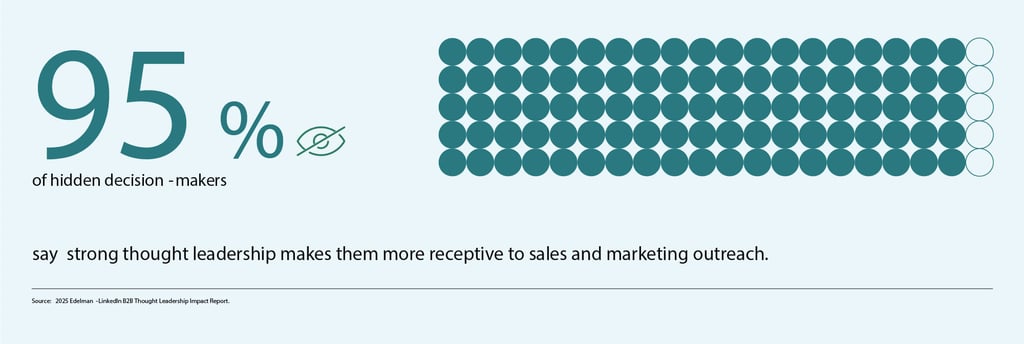
B2B buying processes involve long cycles, multiple decision-makers, technical parameters, and increasingly strict quality and sustainability standards. This calls for brands that project technical authority and reliability.95% of the audience is not in-market
Marketing science shows that only a small share of the audience is actively considering a purchase, on average just 5% at any given time. Thought Leadership is precisely what works for the other 95% by building brand engagement and trust before purchase intent emerges.Decision-makers seek clarity, not noise
For example: in the construction sector, brands are valued for their interpretation of developments, their experience, and their practical applicability. Brands that project stronger authority are therefore embraced more quickly.
Content Marketing
Focuses on visibility
Is about informing
Aimed at the funnel
Responds to questions from the market
Why is Thought Leadership crucial, especially today?
Thought Leadership
Focuses on providing direction
Is about interpreting, explaining, and looking ahead
Aimed at long-term brand growth
Anticipates what is to come
Thought Leadership ≠ Content marketing
Thought Leadership is not about distributing isolated ideas or publishing as much content as possible. It is about exerting influence by offering insight, direction, and clarity in a world where choices are becoming increasingly complex. True thought leadership stands out through sharp insight and an original perspective on developments that truly matter. It not only helps people make better-informed decisions but also gives them an advantage by revealing what others have not yet noticed. Below are the key characteristics of strong thought-leadership content.
1. Thought leadership solves a real problem
Addresses a current challenge, risk, or missed opportunity.
Offers a new, relevant perspective for the target audience.
Helps people make smarter decisions or avoid mistakes.
It’s not about what an organization wants to say, but what the audience needs to know right now.
2. Thought leadership begins with a big, original idea
The problem is the starting point; the unique idea is what differentiates.
Presents a surprising, well-substantiated vision.
Is recognizable, memorable, and deviates from the standard.
Is willing to question or reframe established assumptions.
3. Strong thought leadership is framed like journalism
Answers the questions: Why now? For whom? What does this help with?
Places the insights in a clear context.
Immediately clarifies what decision or change is needed.
4. The format follows the content
The idea comes first; only then follows the format (article, video, presentation, research).
The chosen format supports and amplifies the message.
5. Thought leadership targets specific stakeholders
Big ideas are not defined only by senior leaders.
Signals and insights come from different teams, regions, and disciplines.
This makes the content feel lived and authentic, not imposed from above.
6. Strong content performs by being useful
Decision-makers don’t lack content — they lack time and clarity.
Thought leadership earns attention by being relevant and practically applicable.
Utility comes first, not volume.
7. Thought leadership is written with discipline and style
Clear, structured, and easy to read.
With a recognizable voice and without unnecessary words.
Stories strengthen the message rather than overshadow it.
Characteristics of stong
Thought Leadership




1. It builds brand engagement
By staying relevant in critical buying situations, such as: regulations, ESG, Total Cost of Ownership, or system solutions, you increase the likelihood that your organization becomes top-of-mind when the market begins to shift.
2. It strengthens brand authority within the value chain
In the manufacturing industry, much revolves around trust, quality, and risk reduction. Thought Leadership directly supports the values that matter most to decision-makers such as procurement teams and executive boards, as well as internal influencers across the organization.
3. It enables market innovation and new business models
New Business Development gains momentum when innovations and new market segments are connected to trends, sustainability, and regulation. Thought Leadership helps accelerate these developments by framing them within meaningful propositions.
4. It increases the effectiveness of sales and marketing
Because Thought Leadership raises the knowledge level of the market, commercial conversations become shorter, more strategic, and more valuable. This improves lead management, brand positioning, and funnel optimization.
Thought Leadership is not a marketing activity, but a strategic mindset.
Thought leaders influence the attitudes and behaviors of their audiences. It works because it provides direction, clarity and confidence in markets that are becoming increasingly complex.
It is the point where your experience, strategic marketing, brand positioning, sustainability insights and value-chain expertise come together. It is the process of amplifying the visibility of specialized expertise and accelerating market-shaping influence in order to achieve marketing goals, such as strengthening a brand or generating new business.
Role within Marketing-Communication
1. Claim a future-proof theme
Not too broad (e.g., sustainability), not too narrow, but strategically relevant.
For example: The future of circular air- and watertight building systems . A theme aligned with practical experience and ESG initiatives.
2. Understand Category Entry Points
Research:
when customers think about the category
which triggers they experience
who is involved in the decision process
which risks or KPIs matter most
This forms the foundation of mental availability in B2B.
3. Build a consistent storyline
With a clear point of view on:
what is changing
why it is changing
what this means for organizations in the value chain
which strategic choices are needed now
4. Support it with evidence and real-world examples
Such as:
case studies
research data
whitepapers
insights on performance or sustainability
This approach aligns with the need for credibility and technical authority in B2B manufacturing environments.
5. Repeat and distribute the story across all channels
From trade media to conferences, from sales presentations to digital platforms.
Consistency increases recognition and mental availability.
So how do you become a Thought Leader?
Referring to:
- Article "Elevating your brand's authority and driving business growth" - Lee Frederiksen PH.D.
- Article: "What's the best B2B Thought-Leadership Content" - Rhea Wessel in Forbes.com
- Research: "2025 Thought Leadership Impact Report. Invisible Influence: Unlocking the power of hidden buyers" - Edelman | LinkedIn
Contact
Also visit my UK profile on LinkedIn or request my CV in Dutch, English, or German.
benno.nijenhuis@outlook.com
+31 6 18724238
© 2025. Benno Nijenhuis