
Rome wasn't built in a day
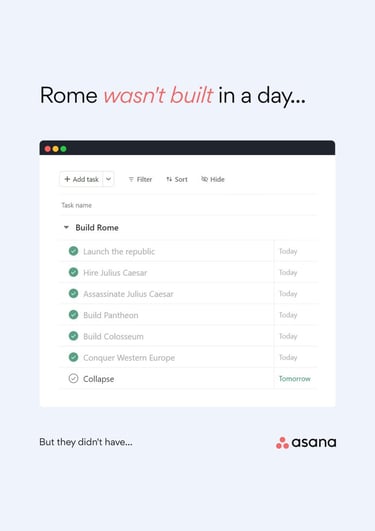
But if they had had an AI project management tool back then, the planning would probably have been completed on time. Tasks neatly created, activities tightly structured, milestones visualized. From founding the republic all the way through to forward-looking strategy.
ROOFS COLUMN- FROM THE SIDELINES
2/11/20263 min read
Rome wasn't built in a day
But if they had had an AI project management tool back then, the planning would probably have been completed on time. Tasks neatly created, activities tightly structured, milestones visualized. From founding the republic all the way through to forward-looking strategy.


It is both ironic and compelling at the same time,the advertisement by Asana. Asana is a project management system that, like much cloud software (Canva, Adobe, Figma), has now deeply integrated AI. In theory, the construction sector,or more specifically, the roofing industry,should be able to adopt this seamlessly.
We are good at organizing. At structuring. At estimating, planning, building dashboards for roof management, and documenting processes. So why does connecting to this development still feel so uncomfortable?
Perhaps because we risk falling into AI-washing. Or should I say: simply adding AI. A smart search function here, a chatbot there, an automated report elsewhere. More a form of marketing automation than true artificial intelligence.
REAL CHANGE WORKS DIFFERENTLY
AI is not a software issue, but a behavioral one. It is not about tools, but about choices. About having the courage to decide before the necessity arises. And about accepting that existing structures may no longer fit what is coming. This requires not only proactivity, but above all a change in behavior.
And yes, that is uncomfortable. The roofing industry is inherently conservative,not out of unwillingness, but out of craftsmanship. We work with proven systems, familiar materials, and trusted processes. So we prefer to stick with what works rather than what is not yet fully proven. Understandable. But that is precisely what makes our sector vulnerable to real disruption.
Artificial intelligence can truly add value here: less hierarchy, lower failure costs, and above all the avoidance of loss-making projects. In other words: more purpose and more autonomy.
But do not fall into the trap of AI-washing. Existing software gets a new label, a futuristic interface, and an appealing marketing story. At its core, little changes, except the narrative. Real AI is not an extra layer; it is a redesign of how work is organized. From work preparation to procurement, from quality control to customer communication. Not to replace people, but to make work smarter and more effective.
THE URGENCY IS ONLY INCREASING
Aging is no longer a trend, but a reality. Skilled workers are leaving faster than they are entering, while demand for housing construction, renovation, and sustainability continues to grow. We want to do more with fewer people, at lower failure costs. That is no longer an efficiency issue. It is a design flaw.
The prefab sector illustrates this sharply. Technically, we are more than capable of producing homes at high speed. Yet those homes then get stuck in a permitting system designed for control, not for speed. This is exactly where AI can make a difference: by making permitting processes predictable, verifiable, and largely automated. So that construction can accelerate without sacrificing quality or due diligence.
Artificial intelligence only becomes truly interesting when it enables the sector to operate differently. Not by doing the same things more efficiently, but by asking different questions. Why do we still plan as we did ten years ago? Why do we accept failure costs as a given? And why is BIM still not widely adopted in the roofing industry?
AI can accelerate this, but only if we are willing to let go. Let go of fixed role divisions, linear phasing, and above all the idea that control equals certainty.
The question remains whether AI is the proven path for change in the roofing industry. Perhaps it is not suited to it at all. But even then, it is wise to keep this topic on the agenda.
Because Rome did not fall due to a lack of planning, but due to a failure to adapt. And that risk is present again today
Contact
Also visit my UK profile on LinkedIn or request my CV in Dutch, English, or German.
benno.nijenhuis@outlook.com
+31 6 18724238
© 2025. Benno Nijenhuis