
It looks like it’s going to be another colorless summer.
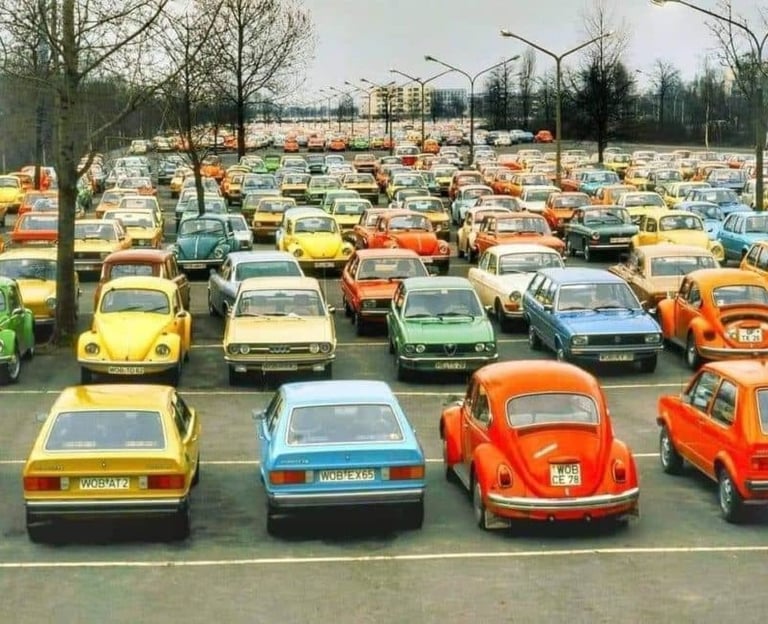
And no, this time I’m not talking about the weather. Take a look at any random parking lot today. Chances are you’ll mostly see black, gray, white, and maybe a bit of dark blue. Functional, sleek, businesslike, but also… a bit boring. Now compare that to parking lots in the late 1970s and early 1980s.
FOCUS
2/26/20262 min read
It looks like it’s going to be another colorless summer.
It looks like it’s going to be another colorless summer. And no, this time I’m not talking about the weather.
Take a look at any random parking lot today. Chances are you’ll mostly see black, gray, white, and maybe a bit of dark blue. Functional, sleek, businesslike, but also… a bit boring.
Now compare that to parking lots in the late 1970s and early 1980s.
The photo above shows it beautifully: a vibrant mix of colors on four wheels. Yellow, orange, green, light blue, red. Cars weren’t just a means of transport, they were also a bit of a personal statement. Every model had its own character, every color stood out.
And perhaps even more importantly: they evoked memories.
As a child, I sat in the back seat of a few remarkable examples:
A brown Austin Allegro
With plastic upholstery. Anyone who experienced it knows: in summer, that material would get scorching hot. Getting in was sometimes a bit of a challenge. But it was part of the experience.A beautiful bright green Simca 1100
A color you hardly ever see anymore today. But back then, it definitely made you stand out in traffic.
For me, those cars symbolize a time when driving may have been less comfortable than it is now, but had far more character. No giant screens, no digital dashboards, no driver-assistance systems doing everything for you. But there were windows you rolled down by hand, dashboards with real buttons, and long holiday drives to France where the back seat sometimes felt more like a camping spot than a car seat.
Why are cars so colorless today?
Interestingly, this has little to do with taste alone. Several factors play a role:
Resale value — neutral colors sell better second-hand
Leasing culture — companies tend to choose safe colors
Production efficiency — fewer color options mean lower costs
Design trends — minimalism has become popular
The result? A parking lot that now looks more like a palette of grays than a celebration of color.
But perhaps we’re missing something today.
Color brings emotion. Color creates recognition. And color tells a story. Many people can still vividly remember their first car (especially from the ’70s and ’80s): not just the brand and model, but also the color. That bright red hatchback, that mustard-yellow station wagon, or that mint-green city car.
Those are the details that stick. So maybe it’s time to bring back a bit more boldness on four wheels.
Anyone who grew up in the ’70s, ’80s, or ’90s has a memory like this. Maybe you were sitting in the back seat on long holiday trips. Maybe it was your parents’ car. Or maybe your own first car that you proudly drove around in.
🚗 Which car memory takes you back to the early 1980s?
Contact
Also visit my UK profile on LinkedIn or request my CV in Dutch, English, or German.
benno.nijenhuis@outlook.com
+31 6 18724238
© 2025. Benno Nijenhuis