


Dare to listen!
We live in a time when every word is weighed before it’s put on paper. A time when marketers no longer dare to trust their gut feeling, but wait for the outcome of thorough internal research with ten checkboxes and three approval rounds, where clarity gives way to caution. But all right, let’s give it a try anyway.
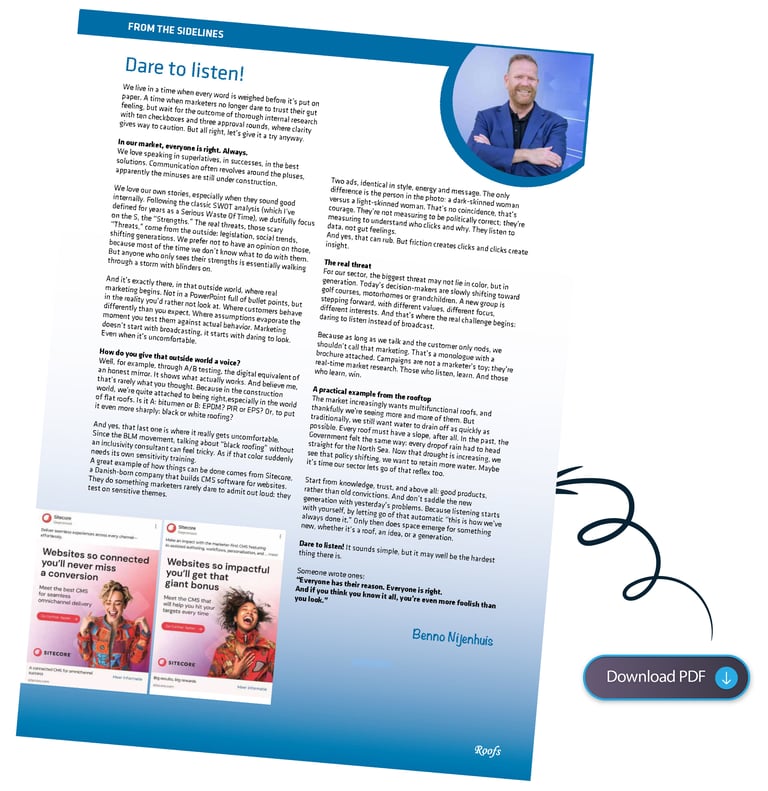
In our market, everyone is right. Always.
We love speaking in superlatives, in successes, in the best solutions. Communication often revolves around the pluses, apparently the minuses are still under construction.
We love our own stories, especially when they sound good internally. Following the classic SWOT analysis (which I’ve defined for years as a Serious Waste Of Time), we dutifully focus on the S, the “Strengths.” The real threats, those scary “Threats,” come from the outside: legislation, social trends, shifting generations. We prefer not to have an opinion on those, because most of the time we don’t know what to do with them. But anyone who only sees their strengths is essentially walking through a storm with blinders on.
And it’s exactly there, in that outside world, where real marketing begins. Not in a PowerPoint full of bullet points, but in the reality you’d rather not look at. Where customers behave differently than you expect. Where assumptions evaporate the moment you test them against actual behavior. Marketing doesn’t start with broadcasting, it starts with daring to look. Even when it’s uncomfortable.
How do you give that outside world a voice?
Well, for example, through A/B testing, the digital equivalent of an honest mirror. It shows what actually works. And believe me, that’s rarely what you thought. Because in the construction world, we’re quite attached to being right,especially in the world of flat roofs. Is it A: bitumen or B: EPDM? PIR or EPS? Or, to put it even more sharply: black or white roofing?
And yes, that last one is where it really gets uncomfortable. Since the BLM movement, talking about “black roofing” without an inclusivity consultant can feel tricky. As if that color suddenly needs its own sensitivity training.
A great example of how things can be done comes from Sitecore, a Danish-born company that builds CMS software for websites. They do something marketers rarely dare to admit out loud: they test on sensitive themes. Two ads, identical in style, energy and message. The only difference is the person in the photo: a dark-skinned woman versus a light-skinned woman. That’s no coincidence, that’s courage. They’re not measuring to be politically correct; they’re measuring to understand who clicks and why. They listen to data, not gut feelings.
And yes, that can rub. But friction creates clicks and clicks create insight.
The real threat
For our sector, the biggest threat may not lie in color, but in generation. Today’s decision-makers are slowly shifting toward golf courses, motorhomes or grandchildren. A new group is stepping forward, with different values, different focus, different interests. And that’s where the real challenge begins: daring to listen instead of broadcast.
Because as long as we talk and the customer only nods, we shouldn’t call that marketing. That’s a monologue with a brochure attached. Campaigns are not a marketer’s toy; they’re real-time market research. Those who listen, learn. And those who learn, win.
A practical example from the rooftop
The market increasingly wants multifunctional roofs, and thankfully we’re seeing more and more of them. But traditionally, we still want water to drain off as quickly as possible. Every roof must have a slope, after all. In the past, the Government felt the same way: every dropof rain had to head straight for the North Sea. Now that drought is increasing, we see that policy shifting, we want to retain more water. Maybe it’s time our sector lets go of that reflex too.
Start from knowledge, trust, and above all: good products, rather than old convictions. And don’t saddle the new generation with yesterday’s problems. Because listening starts with yourself, by letting go of that automatic “this is how we’ve always done it.” Only then does space emerge for something new, whether it’s a roof, an idea, or a generation.
Dare to listen! It sounds simple, but it may well be the hardest thing there is.
Someone wrote ones:
“Everyone has their reason. Everyone is right.
And if you think you know it all, you’re even more foolish than you look.”
Contact
Also visit my UK profile on LinkedIn or request my CV in Dutch, English, or German.
benno.nijenhuis@outlook.com
+31 6 18724238
© 2025. Benno Nijenhuis